

I’ve been in a lot of pipeline reviews over the years.
The pattern is almost always the same. Revenue target missed. Conversation circles back to two suspects: sales execution and market conditions. Sales wasn’t aggressive enough. The market tightened. Enterprise cycles got longer.
Rarely does anyone look at the demand generation system upstream of the pipeline. Rarely does anyone ask whether marketing was actually building the conditions that make outbound work, or whether they were optimising for an entirely different set of objectives.
That’s the gap I’ve spent the last year writing about on this blog. And now I’ve put it all in one place.
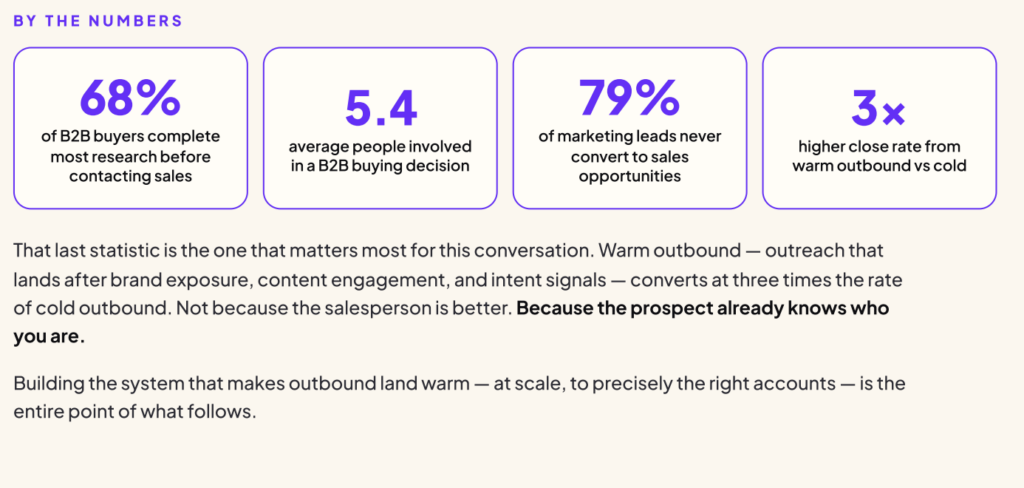
| The Pipeline Generation Playbook — free download
24 pages. 10 chapters. No form. No follow-up. Just the playbook. |
What it is – and who it’s for
The Pipeline Generation Playbook is a 24-page guide for CROs, Sales Directors, and Heads of Sales who are tired of blaming the channel when the real problem is the system behind it.
It’s not a marketing textbook. It doesn’t talk about brand equity or share of voice or thought leadership in the abstract. It talks about the number on your quarterly review, the gap between what marketing reports and what sales actually works with, and why that gap exists structurally, not because your marketing team is bad at their jobs.
It gives you the language and the framework to have the right conversation about how to fix it. And it ends with a 14-question revenue audit you can run on your own programme in an afternoon.
“Most B2B companies don’t have a sales problem or a market problem. They have a demand generation problem dressed up as a sales problem.”
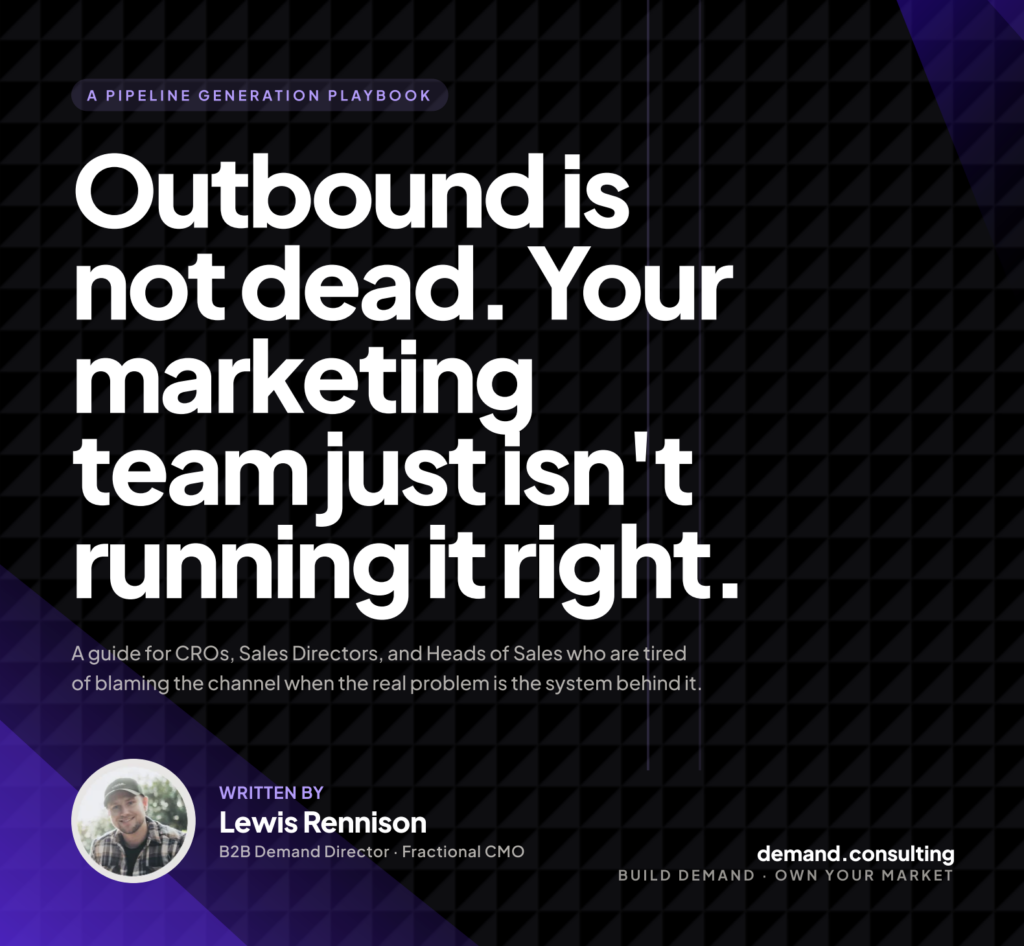
What’s inside – 10 chapters
| CH 01 | The Pipeline Problem Nobody Wants to Say Out Loud
The structural misalignment between what marketing is built to deliver and what sales actually needs. Why this gap is organisational, not personal. |
| CH 02 | Why Outbound Isn’t Dead (It Just Looks Different Now)
The 2018 playbook is broken. Here’s exactly what’s replaced it — and why the companies treating it like 2018 are the ones whose SDRs are burning out. |
| CH 03 | The Brand Problem: Why Your Outbound Lands Cold
Brand redefined for a sales leader. Not “share of voice” — the difference between a prospect opening your email and deleting it without reading the first line. |
| CH 04 | What “Coordinated Demand Gen” Actually Means
The difference between integrated marketing (the same brief sent to five agencies) and a system where every channel builds context for the next one. |
| CH 05 | The AiOS Model: Always-On Sales
Why campaigns reset and infrastructure compounds. The four permanently running layers of a demand engine that doesn’t need switching back on each quarter. |
| CH 06 | The 4-Channel System That Generates Pipeline
The exact architecture behind $7.83M in qualified pipeline, $1.52M closed-won, 164 deals. LinkedIn ads → content → intent tracking → personalised outbound. |
| CH 07 | The Marketing Gap
Five specific reasons in-house marketing teams structurally struggle to deliver pipeline — and why it’s a leadership and structure problem, not a talent problem. |
| CH 08 | What a Proper Demand Programme Looks Like
Four characteristics that distinguish a revenue-generating demand programme from marketing activity. What it’s measured on. How it’s structured. Who runs it. |
| CH 09 | The Revenue Audit
14 questions across 5 sections. Targeting, brand presence, intent signals, outbound architecture, pipeline attribution. Run it with your head of marketing and your most senior SDR. It will tell you exactly where the system is leaking. |
| CH 10 | What to Do on Monday Morning
Three paths depending on where you are: starting from scratch, foundations in place but system not working, or ready to build properly. And the honest case for outside expertise. |
A note on Chapter 7
Chapter 7 is the one I’d start with if I were you.
It’s the chapter that names the five ways in-house marketing teams get misaligned from pipeline generation. It’s not an attack on marketing people — they’re, by and large, doing exactly the job they were hired and incentivised to do. The problem is that the job they were hired for and the job of generating pipeline are different jobs. And most B2B companies are running them as if they’re the same.
The five misalignments are: optimising for MQLs not pipeline, campaigning instead of building infrastructure, not being able to move fast enough on intent signals, not being built for outbound proximity, and lacking the specialist skill set for the modern demand gen stack.
If you’ve been sitting in pipeline reviews wondering why marketing’s metrics and your pipeline are telling different stories — that chapter will name exactly why.
The Revenue Audit — Chapter 9
The most useful thing in the playbook isn’t the framework or the case study numbers. It’s the audit.
15 questions across five sections. Takes about 45 minutes to work through properly with your head of marketing and a senior SDR. The questions aren’t comfortable — they’re designed not to be. They find the exact places where your demand programme is structurally disconnected from pipeline.
The sections are: Targeting and Account Intelligence, Brand Presence in Target Accounts, Intent Signal Monitoring, Outbound Architecture, and Pipeline Attribution.
If you answer “no” or “I’m not sure” to more than half, you have a demand generation architecture problem. Not a sales execution problem. Not a market problem. An architecture problem. And that’s fixable.
“The pipeline gap isn’t because your SDRs aren’t good enough. It’s because the system upstream of them isn’t generating the conditions they need to succeed.”
How to use this
Three ways people will find this useful:
- Read it before your next pipeline review. Chapter 1 gives you the language to redirect the conversation from “sales execution” to “demand system architecture.” That’s a more productive and more honest conversation.
- Run the Revenue Audit with your team. Set aside 45 minutes. Work through Chapter 9 with your head of marketing and your most senior SDR together. The combination of perspectives is what makes it useful — you’re looking for where the organisational seams are, not just the technical gaps.
- Share Chapter 7 with your leadership team. If you’re a CRO trying to make the case for why your in-house marketing team needs different support, Chapter 7 makes that argument without needing to blame anyone.
Download it
No form. No email sequence. No “you’ll also receive our weekly newsletter” checkbox. Just the playbook.
If it’s useful and you’d like to talk about what the diagnosis looks like for your specific programme — that’s what I do. A structured 45-minute conversation. No deck.
| The Pipeline Generation Playbook — free download, no email needed.
24 pages · 10 chapters · demand.consulting |